The oldest birth chart we know of fits in the palm of your hand. It's a clay tablet, pressed in cuneiform, dated to 29 April 410 BCE. A Babylonian scribe recorded where the Sun, the Moon, and the five visible planets sat on the day a particular child was born.
Two and a half thousand years later, the chart a piece of software draws for you does the same job. Same planets. A few more decimal places.
A birth chart is a map of the sky at the exact moment you were born, drawn from the exact place on Earth where you were born. That second half is the part people skip, so hold onto it. The chart isn't a general picture of the heavens that night. It's the view from one window, at one minute, from one patch of ground, and it never repeats in quite the same arrangement again.
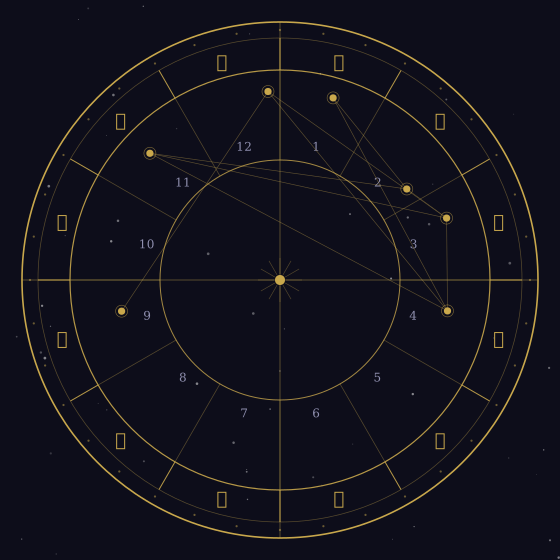
Most people meet their chart as a circular diagram crammed with symbols and lines, feel a small wave of panic, and close the tab. That reaction is fair. The good news is that the wheel is built from four simple ideas stacked on top of each other, and once you can name them, the whole thing stops looking like a circuit board.
Your Chart Is a Photograph of One Particular Sky
Picture the sky as a great wheel turning slowly around you. The Sun, the Moon, and the planets each sit somewhere on that wheel, like hands on a clock that move at wildly different speeds. The chart freezes that clock at the second you took your first breath.
Because the Earth spins, the whole arrangement looks different depending on where you're standing and what time it is. Someone born in London at the same instant as someone born in Sydney sees a different slice of sky overhead and a different point rising in the east. So a chart needs three things to be accurate: the date, the time, and the place. Miss the time, and a large part of the chart goes soft.
A chart records. It doesn't dictate. The Babylonian scribes who started this whole tradition were tracking where the planets were, building a dataset, looking for patterns. They weren't claiming the planets pushed events around like billiard balls, and the honest version of chart reading today keeps that humility. Your chart is a description of a sky, and a language for thinking about character and timing. Treat it as a mirror, not a leash.
The Three That Do the Heavy Lifting
If you remember nothing else, remember these three. People in astrology call them the "big three," and between them they carry most of what a beginner wants from a chart.
The Sun: the sign you already know
Your Sun sign is the one you'd give at a party. It's set purely by your date of birth, because it marks which of the twelve zodiac zones the Sun was passing through that day. The Sun moves at a steady pace through one sign roughly every thirty days. It's the part of the chart tied to your core drive, your sense of self, the thing you're growing toward over a lifetime.
It's also the shallowest reading on its own, which is why horoscope columns built entirely on Sun signs feel so generic. One twelfth of the human race does not share your Tuesday. The Sun is one ingredient.
The Moon: the inner weather
The Moon moves fast. It races through the entire zodiac in about twenty-seven days, changing signs every two and a half days or so. Your Moon sign describes your inner life: how you feel things, what soothes you, the texture of your reactions before you've had time to think. If the Sun is who you're becoming, the Moon is who you are at 3am.
Because the Moon shifts so quickly, two people born on the same date a day apart can have different Moon signs. This is the first hint of why "what's your sign" barely scratches the surface.
The Rising sign: the front door
The rising sign, or Ascendant, is the zodiac sign that was climbing over the eastern horizon at your moment of birth. It's the most time-sensitive point in the whole chart. The entire zodiac rolls past the horizon in roughly twenty-four hours, which means the rising sign changes about every two hours. Get your birth time wrong by ninety minutes and you can land on the wrong one entirely.
The Ascendant is often described as the mask you wear, the first impression, the way you meet the world. It also sets the framework for the houses, which we'll get to. The rising sign is the single best argument for digging up your exact birth time rather than guessing.
Signs Are Not the Constellations They're Named After
Here's a thing that surprises almost everyone. The twelve signs of the zodiac are not the twelve star constellations of the same names. They're equal slices of a circle.
The Babylonians divided the Sun's yearly path across the sky, the ecliptic, into twelve equal zones of thirty degrees each, somewhere around the fifth century BCE. They borrowed the names from constellations that happened to lie along that path, but the slices are mathematical, not astronomical. Aries the sign is a thirty-degree block of sky. Aries the constellation is an irregular scatter of stars that doesn't fill its block neatly at all.
Western astrology measures these slices from the spring equinox, the point where the Sun crosses the celestial equator each March. That's called the tropical zodiac, and it's tied to the seasons rather than to the fixed stars. There's a slow complication here worth flagging: the Earth's axis wobbles over a 26,000-year cycle, a motion the Greek astronomer Hipparchus of Nicaea worked out in the second century BCE using Babylonian eclipse records. That wobble, called precession, has gradually slid the tropical signs out of alignment with the visible constellations. It's the reason you'll sometimes read that your "real" sign has changed. The short version: Western charts use the season-based zodiac on purpose, so the signs haven't moved within that system. The constellations drifting behind them is a separate story, and we cover it properly in the history series.
Planets, Signs, and Houses: Actors, Costumes, and Stage
This is the single most useful mental model for a chart, so it's worth setting out slowly.
The planets are the actors. Each one stands for a kind of energy or function: Venus for love and taste, Mars for drive and anger, Mercury for thinking and talking, and so on through the cast. The signs are the costumes. A planet "in" a sign wears that sign's style, so Mars in careful Capricorn behaves very differently from Mars in impulsive Aries. The houses are the stage, the twelve areas of life where the action plays out: home, work, relationships, money, and the rest.
Read a placement in that order and it forms a sentence. Venus (the actor: love) in Gemini (the costume: curious, chatty) in the seventh house (the stage: partnership) reads roughly as "you love through conversation, and you want a partner you can talk to endlessly." You don't need to memorise a textbook. You need the grammar.
The planets and signs only need an accurate date to place. The houses are the part that demands your birth time and location, because they're anchored to that rising point on the horizon.
A Quick Tour of the Actors
You don't need every planet memorised on the first day. Still, knowing what each one stands for turns the chart from a field of noise into a cast list, so here's the shorthand the tradition has leaned on for centuries.
The Sun and the Moon you've already met, as your core self and your inner life. Mercury is the messenger of the group, governing how you think, learn, and talk, and because it never strays far from the Sun in the sky it tends to land in your Sun sign or one right beside it. Venus is desire and taste: who you're drawn to, how you show affection, what strikes you as beautiful. Mars is the engine. It rules drive, anger, and the particular way you chase what you want or dig in when you're cornered.
Those planets, together with the two lights, make up what astrologers call the personal planets. They move quickly and describe the texture of your day-to-day character. The next pair move slowly and work in broader strokes. Jupiter is expansion, generosity, and the hunger for meaning, and wherever it falls you tend to grow, reach, and occasionally overdo it. Saturn is the colder weather: limits, discipline, responsibility, the lessons that arrive the hard way and the corner of life where you build something durable through plain persistence.
Then there are the three outer planets, none of which the ancients could see, because all three were found only after the invention of the telescope. That's a real oddity in a tradition this old, and astrologers folded them into the system over the last few centuries. Uranus brings disruption and sudden change. Neptune dissolves edges, ruling dreams, imagination, and illusion in equal measure. Pluto works in power, depth, and slow transformation. Because these three crawl through the zodiac across years and decades, they're usually read as the fingerprint of an entire generation rather than a personal quirk, with the house they occupy bringing the theme down to your own life.
Read every planet with the same small formula: what it is, then the sign it's wearing, then the house it's standing in. Do that much for the Sun, the Moon, and the four personal planets, and you've already read the working majority of any chart put in front of you.
Why the Birth Time Matters So Much
Two of the four ideas in your chart depend on the exact minute you were born: the rising sign and the houses.
The houses are twelve segments laid over the wheel, and the Ascendant marks where the first one starts. Move the birth time, and the whole house structure rotates. A planet that sat proudly at the top of your chart can slide into a completely different area of life. This is why a reading done from a guessed time can describe a stranger.
There's an old, very real problem here that ancient astrologers obsessed over. Without a clock, how do you know the exact moment? Hellenistic astrologers used water clocks and tables of "rising times" to estimate the degree of the Ascendant, and they knew the answer was only as good as their timing. Ptolemy, writing in second-century Alexandria, devoted careful attention to the problem in his manual on the subject. The anxiety about birth time is two thousand years old. Modern software solves the arithmetic instantly, but it still can't tell you what the clock on the wall actually said. Only your records can.
If you don't know your time, you're not locked out. Your Sun and Moon and most planetary placements still hold. You simply read the chart without firm houses and without a confident Ascendant, and you treat anything time-dependent as provisional.
Aspects: How the Parts Talk to Each Other
The last layer is the web of lines across the middle of the wheel. Those are aspects, and they describe the angles between planets.
When two planets sit a particular number of degrees apart, astrologers read them as being in conversation. A ninety-degree angle, called a square, suggests friction, the kind of tension that won't let you sit still and tends to push you into action whether you planned it or not. A trine, at a hundred and twenty degrees, is the opposite: ease, flow, talent that arrives cheaply. And when two planets huddle right next to each other in a conjunction, their meanings fuse into a single loud voice.
You can ignore aspects entirely when you're starting out. They're the advanced grammar, the difference between reading a sentence and reading the tone behind it. Come back to them once the actors, costumes, and stage feel familiar.
Where to Actually Start When You Open the Wheel
So you've generated your chart and you're staring at the diagram. Do this, in order, and the panic lifts.
Start with the big three. Find your Sun, your Moon, and your Ascendant, and read them as a trio: Sun for your core, Moon for your inner life, rising for how you meet the world. That one combination already tells you more than any Sun-sign horoscope ever has, and there's a whole guide to what each of the three tells you if you want to start there.
Then find the costumes for the personal planets. Look at where Mercury, Venus, and Mars landed by sign. These three move close to the Sun and shape how you think, love, and act. They're the most personal after the big three, and they add colour fast.
Next, locate the loud spots. Is there a house with three or four planets crowded into it? That area of life carries weight for you. A single planet sitting off on its own at the top of the chart, or out on the eastern edge, is standing in a spotlight of its own. You're hunting for emphasis, not a full inventory.
Finally, sit with the contradictions: a fiery Sun paired with a cautious Moon, or a bold Ascendant pulled over a tender interior underneath. The interesting part of any chart is rarely the tidy agreement. It's the tension between the parts, the same tension you feel in yourself, which is exactly why the thing has held human attention for twenty-five centuries.
One honest caveat to carry through all of it. A chart doesn't predict your future with certainty, and anyone who tells you it does is selling something. What it offers is a structured, surprisingly old language for thinking about who you are and how you move. That's plenty.
The Babylonian scribe with the clay tablet needed years of memorised tables to place seven planets for a single birth. Your chart records the same planets plus the points the Greeks added later, calculated using the VSOP87 planetary model developed at the Paris Observatory and accurate to a fraction of a degree.
Enter your date, time, and place below. Then read it back using everything above.
Calculate Your Birth ChartOr, if you would rather have it read back to you than work through it yourself, the full birth chart report does exactly that, in about twenty pages for $29.